
MCP Registry
Apify MCP server
Connect your agent to the largest marketplace of tools for AI.
The official Apify Model Context Protocol (MCP) server gives AI agents web scraping, data extraction, and browser automation through thousands of ready-made Actors from Apify Store, at https://mcp.apify.com.
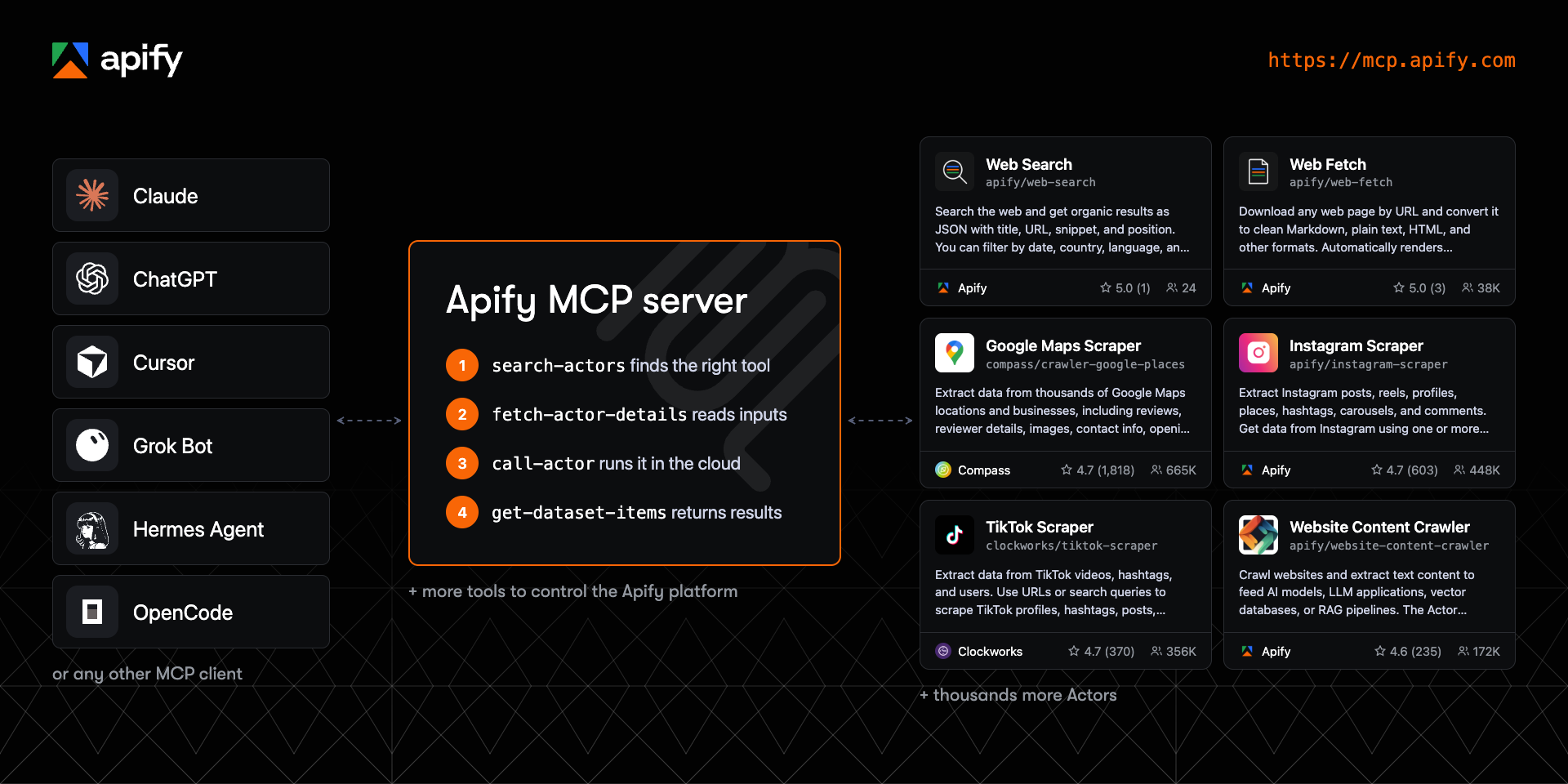
Apify is the marketplace of ready-to-run tools for AI agents. One connection to the Apify MCP server gives your agent thousands of tools to choose from, for jobs like web fetch, SERP monitoring, lead generation and enrichment, and pulling data from e-commerce sites and social media. The server loads only what each task needs.
Your agent searches Apify Store, checks an Actor's input and pricing, runs it, and reads the structured results, so you don't install a separate MCP server for every site. Connect to the hosted server with OAuth, or run it locally over stdio with the @apify/actors-mcp-server npm package.
Contents
- Quickstart
- Set up your client
- Remote (hosted) or local MCP server
- How an agent uses Apify Actors
- Tools, resources, and prompts
- Choose which tools load
- UI mode configuration
- Example prompts
- Pricing and limits
- Telemetry
- Troubleshooting and limitations
- FAQ
- Development
- Contributing
- Privacy and license
- Learn more
🚀 Quickstart
- Open the MCP configurator, pick your client, and choose the tools you want.
- Copy the generated configuration, deeplink, or command into your client.
- Sign in to Apify in the browser window that opens. If you don't have an account, you can create a free one there.
The hosted endpoint is https://mcp.apify.com. If your client can't use OAuth, send your Apify API token in an Authorization: Bearer <APIFY_TOKEN> header instead. Treat the token like a password and keep it out of repositories.
Using a coding agent such as Claude Code, Codex, Cursor, or GitHub Copilot? An official Apify plugin installs this MCP server together with Apify agent skills in one step.
🤖 Set up your client
The configurator generates the exact setup for each supported client, including Claude Code, ChatGPT, Cursor, VS Code, GitHub Copilot CLI, Claude, Claude Desktop, Codex, OpenCode, Kiro, and more. The snippets below cover the most common cases.
Claude Code
claude mcp add apify "https://mcp.apify.com" -t http
Claude Code opens the Apify sign-in page the first time it uses the server. To install the Apify plugin with Apify agent skills instead, run /plugin marketplace add apify/apify-claude-code-plugin, then /plugin install apify@apify and /reload-plugins.
ChatGPT
- Open ChatGPT Plugins, select +, then Add custom MCP server.
- Name it Apify, enter https://mcp.apify.com as the server URL, and choose OAuth authentication.
- Review the risk warning, select I understand and want to continue, then Create as a plugin.
- Sign in with Apify, review the tools, and install the plugin. No API token is needed.
- Start a new conversation, type @, and select Apify.
In Business, Enterprise, and Edu workspaces, an admin or owner may need to create or publish the plugin. If the option is missing, ask your workspace admin. When the server's tools change, open the plugin and select Refresh.
The ChatGPT desktop app uses local MCP configuration shared with Codex instead: go to Settings > MCP servers > Add server, choose Streamable HTTP, and enter https://mcp.apify.com. See OpenAI's custom MCP server guide.
Cursor
Use the one-click install link from the configurator, or let the Apify CLI write the configuration, including your API token:
apify mcp install cursor
The same command works for claude-code, vscode, codex, kiro, and antigravity.
VS Code and GitHub Copilot
Use the one-click install link from the configurator, run apify mcp install vscode, or add https://mcp.apify.com as an HTTP server in your MCP configuration:
Claude
Apify is available as a Claude connector. Open Settings > Connectors, find Apify in the connector directory, and connect it. You can also select Add custom connector, name it Apify, and enter https://mcp.apify.com as the remote MCP server URL. Sign in with Apify when prompted. The same connector works on Claude.ai and in Claude Desktop. See the Claude guide.
Any other MCP client (JSON config)
Most clients that support remote servers and OAuth accept a configuration like this:
Local stdio (npx)
Requires Node.js 22 or later.
If you've run apify login, the server can also read the token saved by the Apify CLI. Run npx @apify/actors-mcp-server --help for all options.
The server is also listed in the Docker MCP catalog, and each release ships an MCP bundle file (apify-mcp-server.mcpb) for one-click installation in clients that support it.
Remote (hosted) or local MCP server
The hosted remote MCP server with OAuth is the recommended option. Use the local server when you want to run the MCP process on your own machine; Actors still run and store their results on the Apify platform in both modes. If your client supports only stdio, you can also bridge it to the hosted server with mcp-remote: npx mcp-remote https://mcp.apify.com.
How an agent uses Apify Actors
Actors are serverless programs on the Apify platform. Each one does a specific job, like scraping Google Maps, crawling a website for RAG, or collecting social media posts. The MCP server turns Actors into tools an agent can find and call without you configuring each one in advance.
A typical task follows four steps:
- search-actors finds candidate Actors in Apify Store for the task.
- fetch-actor-details returns the Actor's input schema, README, and pricing, plus its output schema on request.
- call-actor starts the run and waits for it to finish, 30 seconds by default and up to 45. It returns the run status and storage IDs; the scraped items stay in the run's dataset.
- get-dataset-items reads the results from the run's dataset, with limit and offset for pagination.
The server adds get-dataset-items, get-key-value-store-record, get-actor-run, and abort-actor-run whenever call-actor or an Actor tool is loaded, so the agent can always read results and check on long runs that outlast the wait.
You can also expose a specific Actor as its own tool, for example apify/web-search or apify/instagram-scraper. The server builds the tool's parameters from the Actor's input schema, so the agent knows exactly what to pass.
Actors that run their own MCP server. Some Actors are MCP servers themselves. fetch-actor-mcp-tool-list lists their tools, and call-actor-mcp-tool calls one. When such an Actor is loaded as a tool source, its tools are exposed under names in the form username--actor-name--tool-name. Apify Store also lists MCP-related Actors from independent creators; those are separate products with their own READMEs and pricing.
🛠️ Tools, resources, and prompts
Any Actor can be a tool, and agents discover new ones as they work. By default, the server loads the actors and docs categories, two Actor tools (RAG Web Browser and Web Fetch), and report-problem. Everything else is opt-in by category or by tool name.
Helper tools
Besides Actor tools, the server provides helper tools for the Apify platform:
- Actors: search Apify Store, list the Actors in your account, view their details, call tools on Actors that run MCP servers, send requests to Server Actors, and delete your own Actors.
- Documentation: search the Apify and Crawlee docs and fetch pages as context.
- Runs and storage: list runs, inspect them, read their logs, and read datasets and key-value stores.
- Tasks and schedules: manage saved Actor tasks and their public landing pages, and schedules that run Actors and tasks automatically.
- Builds and versions: build Actors, read build logs, and create, read, change, copy, and delete versions from files.
- Apify API: search the API reference, inspect an operation, and send requests to read or change data.
Available tools
Legend for the Enabled by default column:
- ✅ In the default tool set.
- ⚡ Added automatically when call-actor, an Actor tool, or get-actor-run is loaded, which is true in the default configuration.
- ✅¹ Served by default only when telemetry is on and the client name doesn't contain claude, anthropic, or local-agent-mode. Select it explicitly with tools=report-problem or tools=dev to serve it to any client; telemetry still has to be on.
The tasks category manages saved Actor tasks. It is unrelated to the MCP Tasks protocol. The tool reference has full descriptions of each tool.
Tool annotations
Every tool carries a title, a readOnlyHint, and an openWorldHint. readOnlyHint is true for tools that only read data. Actor tools get it only for Apify-maintained Actors with limited permissions and no inputs that accept secrets, writable storage, an MCP connector, or code; other Actor tools are marked destructive. openWorldHint is true for tools that reach outside the Apify platform, such as call-actor, and false for platform-only tools.
Prompts and resources
No prompts are registered yet, so prompts/list returns an empty list. resources/read accepts any Apify API GET URL (https://api.apify.com/v2/...) and returns the response body using the session's Apify token, inlined up to 256 KB. Your data isn't enumerated in resources/list; resources/templates/list lists the common shapes with their paging parameters.
Choose which tools load
The tools parameter takes categories, tool names, and Actor names, separated by commas. When you set it, the defaults are dropped and only what you list is loaded, plus the ⚡ run and storage tools whenever the list includes call-actor or an Actor. The easiest way to build a selection is the configurator.
Hosted server:
https://mcp.apify.com?tools=actors,docs,apify/web-search,apify/web-fetchLocal server:
npx @apify/actors-mcp-server --tools actors,docs,apify/web-search,apify/web-fetch
To give an agent a single Actor, list only that Actor. The agent gets its tool plus the four ⚡ tools it needs to read the results:
https://mcp.apify.com?tools=apify/instagram-scraperPin your tools in production. The default tool set can change between versions. Set tools explicitly if you need a stable interface.
Backward compatibility with older configurations
UI mode configuration
The ui parameter controls MCP Apps widget tools. With UI mode on, the server adds search-actors-widget and fetch-actor-details-widget next to their base tools, which keep returning standard responses. By default (auto), UI mode turns on when the client supports MCP Apps.
Hosted server:
https://mcp.apify.com?tools=actors,docs&ui=trueLocal server, with a CLI flag or the UI_MODE environment variable:
💬 Example prompts
Ask in plain language. The agent finds a suitable Actor, checks its input and pricing, runs it, and reads the results. These prompts cover the most common jobs:
Follow-ups work too. "Show me the next 10 results from that run" makes the agent call get-dataset-items again with a higher offset. With the schedules category loaded, "Run that Google Maps search every Monday at 9 am" creates a schedule.
💰 Pricing and limits
- Connecting to the MCP server is free. Actor runs bill to your Apify account according to each Actor's pricing, which fetch-actor-details shows before a run. The Apify free plan includes $5 of monthly platform usage.
- To cap what a run can cost, pass maxTotalChargeUsd (pay-per-event Actors) or maxItems (pay-per-result Actors) in the callOptions of call-actor. timeout and memory limit the run's duration and memory, not its price.
- The hosted server accepts up to 20 requests per second per account.
- search-actors returns only free and pay-per-event Actors that pass the platform's agent-safety filters, so rental and pay-per-result Actors don't appear in search. Full-permission Actors need your one-time approval; until then, call-actor returns an error with an approval link.
- Some tools work without an Apify account: search-actors, fetch-actor-details, search-apify-docs, fetch-apify-docs, apify-api-search, and apify-api-details. Select only those, for example https://mcp.apify.com?tools=search-actors, and the hosted server accepts the connection without a token.
📡 Telemetry
The Apify MCP server collects telemetry about tool calls to help Apify understand usage patterns and improve the service. Telemetry is on by default. With telemetry on, Actor searches in Apify Store send the MCP session ID as _traceId, and tool-call events carry it as trace_id. search-actors also sends _useCase, a one-sentence reason for the search written by the model, which Apify uses to improve Store search results. The stdio transport also uses Sentry for error tracking, which helps the Apify team find and fix issues faster.
https://mcp.apify.com?telemetry-enabled=false🐛 Troubleshooting and limitations
- The local server won't start. Check your Node.js version: the package requires Node.js 22 or later.
- Authentication fails. Reconnect so the client repeats the OAuth flow, or switch to a Bearer token. For the local server, check that APIFY_TOKEN is set in the client's server configuration, not only in your shell.
- Client features vary. Any MCP client can connect, but support for dynamic tool lists, OAuth, and MCP Apps differs between clients.
- Invalid Actor input. When call-actor fails because of invalid input, the error includes the Actor's input schema so the agent can correct the input and retry.
How the server adapts Actor input schemas
The server adapts Actor input schemas so that more clients and models can use them:
For more help, see the MCP documentation or open an issue.
❓ FAQ
What is an MCP server?
An MCP server exposes tools and data to AI agents through the Model Context Protocol, an open standard supported by clients such as Claude, ChatGPT, and Cursor. The agent connects once and calls the server's tools when a task needs them. The Apify MCP server's tools are the Actors in Apify Store.
What is the Apify MCP server?
It's the official Model Context Protocol server for Apify. It lets AI agents search Apify Store, run Actors for web scraping, data extraction, and browser automation, and read the structured results.
When is it a good MCP server for web scraping?
When an agent needs data from many different sites. A typical case is Google Maps one day, Instagram or an online store the next. The agent picks a ready-made Actor for each site from Apify Store instead of you writing and maintaining a scraper. Each Actor works like a web scraping API for its site, and the Apify platform handles scaling, proxies, and storage of the results.
How does it compare to Playwright MCP?
Playwright MCP drives a browser on your machine step by step, through clicks and page snapshots. The Apify MCP server runs Actors in the Apify cloud. Each Actor handles JavaScript rendering, proxies, and blocking for its site and returns structured results, so the agent asks for the data instead of operating a browser. Many agents use both.
Can ChatGPT or Claude scrape websites with it?
Yes. Connect ChatGPT, Claude, or Claude Code to https://mcp.apify.com, then ask in plain language. The model searches for a suitable Actor, runs it, and reads the results.
Is it free?
Connecting is free, and some discovery tools work without an account. Actor runs bill to your Apify account at each Actor's price, and the free plan includes $5 of monthly platform usage.
Do I need an API token?
Not with the hosted server, because OAuth signs you in through the browser. The local server needs APIFY_TOKEN or an Apify CLI login.
Can I limit what the agent can do or spend?
Yes. Select tools with the tools parameter or expose a single Actor. To cap a run's cost, pass maxTotalChargeUsd for pay-per-event Actors or maxItems for pay-per-result Actors in call-actor options.
🔧 Development
This repository contains the open-source server package published to npm as @apify/actors-mcp-server. The hosted service at mcp.apify.com runs on this core logic from a separate private repository.
You need Node.js 22 or later and pnpm.
🤝 Contributing
Bug reports, feature requests, and documentation fixes are welcome. Open an issue with steps to reproduce a bug, or describe the problem a feature would solve and who runs into it. Send typos, broken links, and wrong commands straight to a pull request. For code, work only on an issue a maintainer has invited you to pick up; unsolicited pull requests are closed.
🔒 Privacy and license
Requests and Actor inputs go to the Apify API to run the Actors you call. Apify doesn't share them with third parties beyond what running those Actors requires. See Apify legal documents for details on data collection and retention.
The project is licensed under the MIT license.
📚 Learn more
- MCP documentation: authentication, tool reference, and advanced configuration
- Apify for AI agents: choosing between MCP, plugins, agent skills, the CLI, and machine-readable docs
- Apify agent skills: guided multi-step workflows, installed with npx skills add apify/agent-skills
- Apify CLI: running and building Actors from a terminal
- Model Context Protocol
- MCP for beginners
- How to use MCP with Apify Actors
- Webinar: Building and monetizing MCP servers on Apify