
How DLR Institute of Robotics uses GitHub
Organization Overview
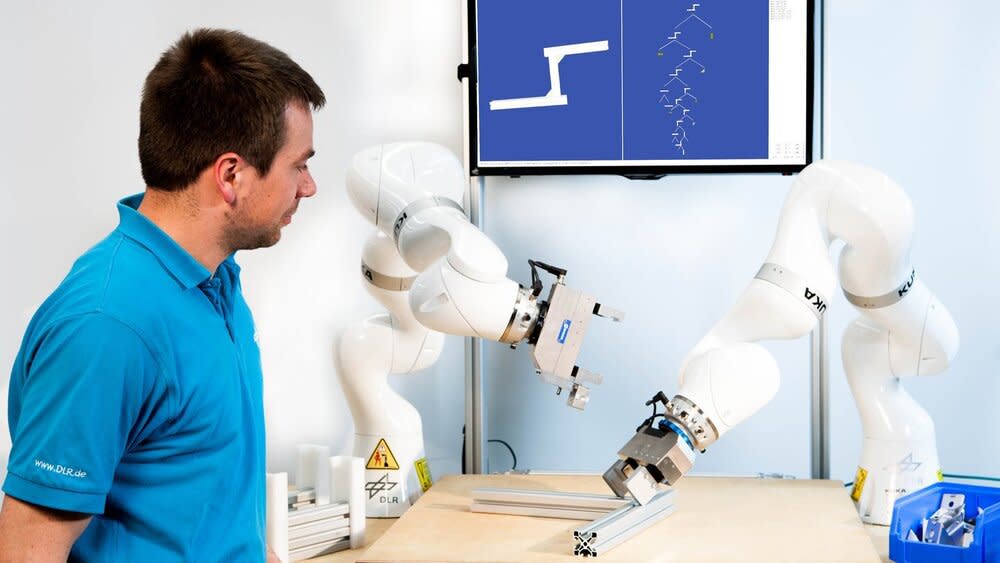
The DLR (Germany's national aeronautics and space research center) has more than 9,000 employees spread across 16 locations in Germany. The DLR Institute for Robotics and Mechatronics (DLR-RM) develops robots to enable humans to interact more safely and efficiently with their surrounding environments.
Industry: Government
Company Size: 500+
Location: Germany
The Challenge
While much of the DLR's software development happened on Subversion (SVN), the DLR-RM team increasingly relied on open source software and Git workflows. As the team began to open source and manage their own robotics systems with Git, developers became accustomed to Git commands and workflows. At the same time, young developers entering the workforce expected to use the same tools at work that they did in school—most notably, GitHub.
"We were seeing a rise in Git usage across the institute," said Berthold Bäuml. "Our IT group wanted to officially support a solution so that developers could continue working the way they preferred, but we needed to make sure it was secure and sanctioned."
The Solution
The DLR-RM's IT group conducted a survey of its internal Git users along with external research and found GitHub to be the best solution.
"GitHub is widely known by open source contributors, it's easy for beginners to use, and it includes additional tools like code review and issue tracking that help our developers focus on creating great software. It became clear that GitHub Enterprise was the best solution."
The DLR Institute for Robotics and Mechatronics now uses GitHub across its software development teams, including electro-technique and computer science, with plans to expand to its machine engineering and electrical engineering teams who work on CAD plans and circuit diagrams.
Implementation and Results
To ensure a seamless transition to GitHub Enterprise, the DLR-RM engaged its most experienced GitHub users to host a series of lectures intended to help developers new to GitHub with questions and challenges they might face.
"Before we were using GitHub, we could count on chaos during rapid development phases. With SVN, it always felt like someone was in your way. Or, developers would just work around the version control system and compromise code quality."
Since rolling out GitHub Enterprise, the team has seen noticeable improvements in its development process, specifically for release cycles that are deadline driven or fast paced. "Developing complex software under pressure, like during the SpaceBot Cup robotics competition, wouldn't be possible without GitHub. It provides the agile workflow necessary for developing research prototypes for robotics, especially before important deadlines," Berthold explains.