
How Buffer uses GitHub
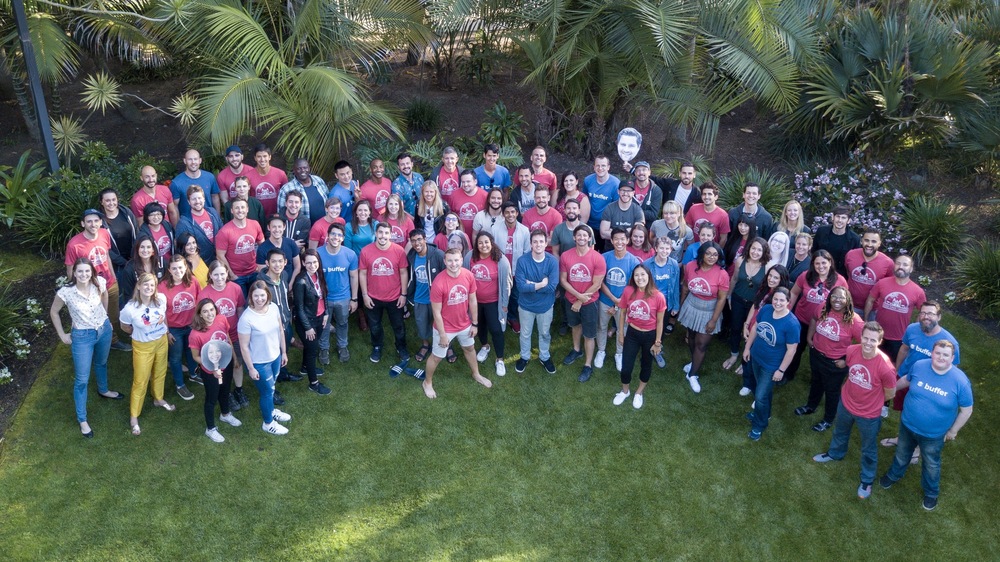
Buffer is a social media management platform serving 75,000 customers worldwide with a fully remote team of 33 developers. The company has used GitHub since 2010 to unite their organization and accelerate product development.

Consolidating knowledge and collaboration
Buffer's distributed team faced challenges with knowledge silos when engineering discussions happened across Zoom and Google Docs. Senior Engineer Joe Birch saw GitHub as an opportunity to centralize communication and decision-making.
The team now conducts architectural reviews directly in GitHub as Markdown documents. When an engineer needs to make an architectural decision, they submit a proposal as a pull request, which becomes the start of the documentation process. "Once any changes are made, they're merged with the discussion history, all within GitHub next to the code that's taking place," Birch explained. "As architecture changes, we know why decisions are being made. This prevents it from getting lost and removes the knowledge silos around those decisions that we were experiencing before."

Streamlining feedback and design workflows
GitHub has shortened the feedback loop for designers and front-end engineers. Front-End Engineer Juliana Gomez noted that designers "can jump in, change stuff around, and make little visual tweaks." In the past, feedback would travel through Jira and take longer to reach the right person.
With GitHub's automated checks and integrated workflows, "we make changes and have automated checks, and we make it easy for teams when we're doing QA, too. That's been really cool and a huge benefit for our designers," said Gomez.
Automation and security with GitHub Actions
GitHub Actions has been the biggest game-changer for Buffer's development process. "We're pretty much using Actions for everything," said Birch. By combining a unit test framework with the Danger JS plugin, the team has simplified their release flow to be as straightforward as pushing a button.
Automated integrations with Slack keep work moving efficiently. "Just give it a webhook URL in the message, and the Slack integration will post it," Birch described.
Buffer also runs Cron scheduling every Wednesday to check if dependencies are out of date. "If they are, it will generate a message and post it to the Slack channel to avoid us having to check it manually." This automation, combined with GitHub's automated security updates, helps the team spend less time on manual maintenance tasks.
Senior Engineer Hamish Macpherson highlighted the impact: engineers previously spent "two hours or more just fixing dependencies that were old or outdated." With automated security updates, this burden has been eliminated. Buffer also hosts a Bug Bounty program to incentivize engineers who address security vulnerabilities.
Faster deployments and better feedback
Using GitHub keeps deployment information transparent and accessible to all developers. "Before it was cryptic services that no one understood," said Macpherson. This transparency helps developers grow in their roles and understand how their code reaches production.
The improved visibility has also accelerated deployments. "Our beta products are definitely seeing a lot more usage because of the ease," said Birch. Faster beta releases mean more frequent customer feedback, which improves production releases. "Being able to get instant feedback from customers is important to us. The more feedback we get, the better our actual production release is going to be."
Open source and recruiting
Buffer is building an open source design system to live up to its core value of transparency. This public presence has become a recruiting advantage. When Buffer hired for their Mobile Team, candidates referenced the company's open source projects, boosting awareness of the engineering organization.
GitHub also plays a role in Buffer's interview process. Candidates review pull requests as guest users to demonstrate how they problem solve.
Gomez shared her own experience: "I was really grateful when I saw that Buffer was using GitHub when I joined because it's a platform I already knew, so it brings down those imposter syndrome feelings. GitHub has always and continues to help me focus on the code, which is what I really just want to do."
Beyond recruiting, the open source community contributes valuable perspective. Birch noted that Buffer has received "quite a few bug fixes" from outside contributors. Macpherson reflected on the broader impact: "our entire front end is built on the shoulders of giants."

Ongoing investment
GitHub has empowered Buffer's developers to take ownership of releases and onboarding. New developers join the team already familiar with the platform, eliminating training overhead. "GitHub allows us to meet our developers where they are. We can't imagine having to train new developers on any other platform," said Birch.
Macpherson concluded, "We'll definitely continue to invest in GitHub because the returns on it have been really invaluable across our workflows, developer happiness, and recruiting."